

A No-Sales-Pitch Guide to Life Insurance Offering Straight Answers Based on Who Actually Depends on You
You’ve heard you “need” life insurance more times than you can count. What nobody tells you is that the real question isn’t whether you need it, it’s whether anyone would be financially stuck if you weren’t here tomorrow. Answer that first, and the rest gets a lot simpler.
Do I Actually Need Life Insurance?
Skip the sales pitch version of this question and ask it the honest way: would someone be financially stuck if I died tomorrow? If yes, you probably need coverage. If no one depends on your income and you don’t carry major debt, you may only need enough to cover final expenses, and that’s a smaller policy than you’d think.
If you have a spouse, kids, a mortgage, co-signed debt, or a business partner, coverage matters. If you’re single with no dependents and minimal debt, a small final-expense policy may genuinely be all you need. Not everyone needs a large policy, and we’ll tell you that straight, even though it’s a smaller sale for us.
Often OverlookedStay-at-home parents need coverage too. Their unpaid work, childcare, household management, transportation, has a real replacement cost, often $30,000 to $50,000 or more per year. The standard “10x income” rule doesn’t apply to someone who isn’t drawing a paycheck, but the gap they’d leave behind is very real.
Nearly 100 million Americans are uninsured or underinsured on life insurance, and more than half say cost is the reason. Most of them are overestimating what it actually costs, often by 10 times the real number.
How Much Is Enough? (Skip the 10x Rule)
The “10x your income” rule is easy to remember and often wrong. It doesn’t account for your actual debt, your mortgage, or how many kids you’re putting through college. The DIME method gets you a real number:
- Debt — total non-mortgage debt
- Income replacement — years of income your family would need
- Mortgage — remaining payoff balance
- Education — estimated cost per child
Add those up, then subtract your savings and any existing coverage. Here’s what that looks like for a real family:
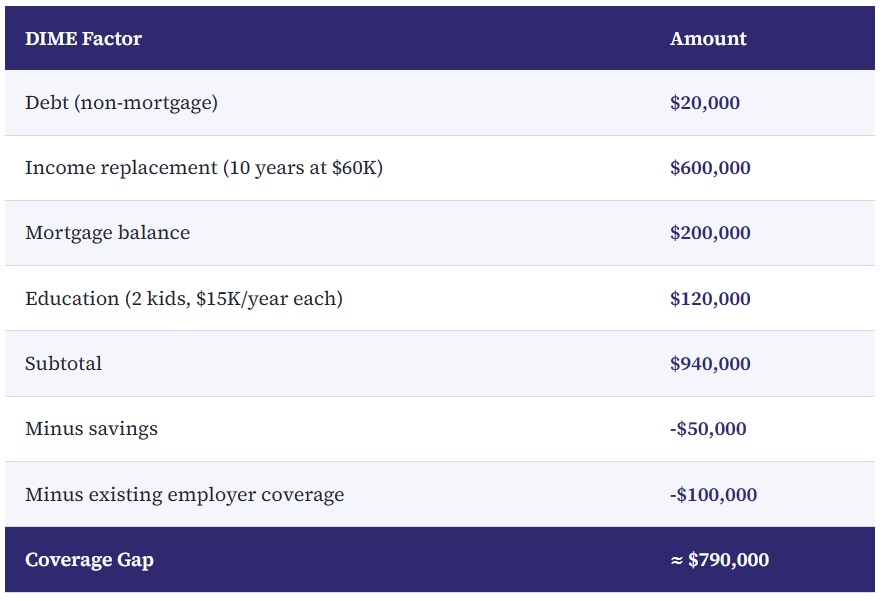
That’s a very different number than “10x a $60K salary” would give you, and it’s specific to this family’s actual obligations, not a guess. Run your own numbers with us and we’ll walk through it together.
Is Life Insurance Through Work Enough? (Usually Not)
About half of employees have life insurance through their employer, and roughly 1 in 4 have coverage only through work. The problem: employer coverage is typically just 1-2x salary, well below what most families actually need. It may not travel with you if you change jobs either, some group plans offer conversion options, but the terms can be more limited or expensive, so it shouldn’t be your only plan without checking the fine print.
Commonly ConfusedEmployer life insurance, personal term life, and mortgage protection insurance are three different things. Mortgage protection pays your lender directly. Term life pays your beneficiary, who decides how the money gets used. Neither one is the same as PMI, which protects your lender if you default and has nothing to do with a death benefit.
Term vs. Whole Life, in Plain English
Term Life
Term life insurance covers you for a set period, 10, 20, or 30 years, and pays a death benefit if you pass during that term. Pure protection, no investment component, which keeps premiums low. Right fit for most families.
Whole / Permanent Life
Whole/permanent life insurance covers your entire life and builds cash value, but costs significantly more. Makes sense for estate planning, a dependent who needs lifelong support, or a business buy-sell agreement.
Match your term length to your actual timeline. A 20-year term covers young kids until they’re financially independent. A 30-year term can line up with your mortgage payoff schedule. The goal is to eventually be “self-insured,” meaning by the time your term ends, you’ve got enough saved that the policy is no longer necessary.
Look for a convertible term policy, one that lets you switch to permanent coverage later without a new medical exam. That flexibility matters if your health changes down the road.
When to Review Your Coverage
Life insurance isn’t a “buy it once and forget it” decision. Revisit your coverage whenever one of these happens:
- Marriage or divorce
- A new baby
- Buying a home
- Starting a business
- A significant change in income
Kansas Buyers, Take NoteKansas gives you a minimum 10-day “free look” period on any new life insurance policy. If it doesn’t say what you thought it did, you can return it within 10 days for a full premium refund, no questions asked.
Name a beneficiary, and a contingent beneficiary too. If you die without one named, the death benefit goes to your estate and follows your will through probate, which delays payment and can create real financial hardship for the people you meant to protect. If you think you or a family member may have a lost policy, the Kansas Insurance Department offers a free, confidential lookup through the NAIC Life Insurance Policy Locator.
Not Sure What You Actually Need?
We’ll run your real numbers, no sales pitch, and tell you honestly whether you need more coverage or less.
This post is for general educational purposes and does not constitute legal or insurance advice. Coverage varies by policy and carrier.