
Last year, 39% of single-vehicle crashes in Kansas involved a deer. Here are answers to your auto insurance questions about what’s covered, what isn’t, and the one mistake that turns a no-fault claim into an at-fault claim.
Does Car Insurance Cover Hitting a Deer? (Only If You Have This Coverage)
A direct deer strike is covered under comprehensive coverage, sometimes called “other-than-collision.” It is not covered by liability, and it is not covered by collision. If your policy only carries Kansas state-minimum liability, a deer strike comes out of your own pocket entirely.
Comprehensive is optional in Kansas. It’s not required by state law, which is exactly why plenty of drivers on older, paid-off vehicles have dropped it to save money. The problem is finding that out the moment you’re standing on the shoulder of a rural highway looking at a crumpled bumper.
Quick Definitions
Comprehensive coverage pays for damage to your vehicle from non-collision causes: animals, hail, theft, fire, falling objects, flooding. Collision coverage pays for damage when you hit another vehicle or a stationary object, like a tree or a ditch.
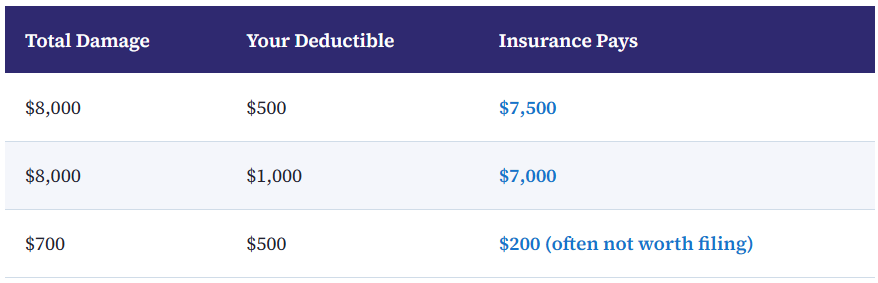
Even with comprehensive on your policy, you still pay your deductible. The deer isn’t your fault, but the deductible still applies:
Hitting the Deer vs. Swerving to Miss It
This is the distinction that trips up more Kansas drivers than anything else, and it’s worth remembering before you’re ever in the moment: what you do in that half-second changes which kind of claim you file.
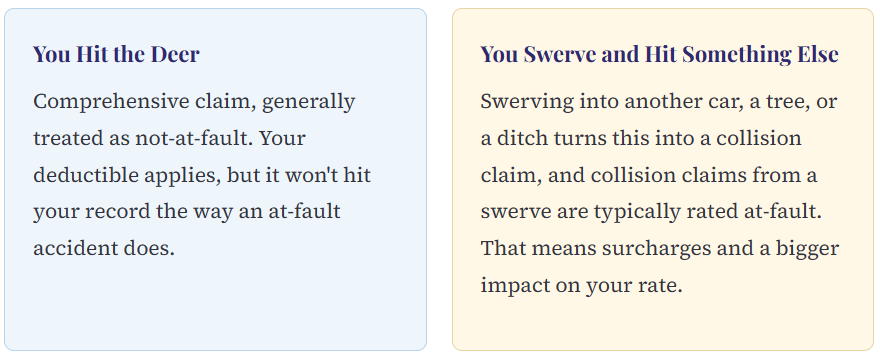
The Kansas Highway Patrol’s safety guidance actually lines up with the insurance math here: at highway speed, it’s generally safer to brake and strike the animal than to swerve. Swerving at speed is how single-car rollovers and head-on crashes happen.
Edge Case
Hitting a deer carcass already lying in the road is often coded as a collision claim rather than comprehensive, since you struck a stationary object rather than a live animal.
Will My Rates Go Up After a Deer Claim? (Honest Answer: Maybe)
Comprehensive claims generally aren’t surcharged the way at-fault accidents are, but Kansas doesn’t prohibit it outright the way some states do. One deer claim usually won’t spike your rate on its own. It does go on your CLUE report, and combined with other claims or tickets down the road, it can affect your renewal.
One practical rule: don’t file a claim that’s smaller than your deductible. If the damage is $700 and your deductible is $500, filing only nets you $200, and it’s now on your record. Paying out of pocket often comes out ahead.
Worth knowing too: if your premium goes up at your next renewal, it’s not automatically the deer’s fault. Repair costs and claim frequency have been climbing statewide, and that’s pushing rates up across the board, regardless of any one driver’s record.
What to Do Right After You Hit a Deer in Kansas
- Pull over safely and turn on your hazards. Do not approach the animal; an injured deer can hurt you.
- Call law enforcement. Kansas requires reporting any crash with $1,000 or more in property damage, or any injury, to the nearest law enforcement agency. Most deer strikes with a modern vehicle clear that threshold easily, and a police report strengthens your claim.
- Document the scene with photos of the vehicle, the roadway, and the damage. Don’t sign anything or admit fault; a deer strike is a no-fault comprehensive event as long as you didn’t hit another object.
- Call us or start your claim. We’ll walk you through it from there.
Kansas Is a No-Fault State
Any medical bills from the crash, yours or your passengers’, go through your Personal Injury Protection (PIP) first, regardless of who or what caused the crash. Every Kansas policy carries a minimum of $4,500 per person in medical benefits, plus wage and rehabilitation benefits. Higher limits are available.
How to Lower Your Odds (and Your Cost) Before October
The numbers are worth taking seriously. Deer were involved in 39% of all single-vehicle crashes in Kansas in 2024, resulting in 5 fatalities and 674 injuries. The average animal-strike claim that year ran $8,430, up 103% over five years.
Peak season runs mid-October through December, with November the worst month statewide during the rut. Be most alert at dawn (6–7 a.m.) and dusk (6–9 p.m.) on rural highways, and use your high beams when there’s no oncoming traffic; they’ll catch a deer’s eyes well before your headlights alone would. Butler and Sedgwick counties, home turf for a lot of our clients, historically lead the state in deer-vehicle crashes.
The one insurance move that actually matters: confirm comprehensive is on your policy now, and check your deductible. If you’ve got an older vehicle and dropped comp at some point, October is the wrong month to find that out the hard way, and you can’t add coverage after a strike and have it apply retroactively. That’s insurance fraud, plain and simple.
Before October, Check Two Things
Make sure comprehensive is on your policy, and know your deductible. Takes five minutes, and it’s the difference between a covered repair and a bill you’re paying out of pocket.