

“I Have Full Coverage” is the Most Expensive Sentence in Auto Insurance
It isn’t a real policy; it means different things to different people, and it can leave a big gap right when you need help. Here’s what to ask instead.
We hear it every week. “Don’t worry, I’ve got full coverage.” It sounds reassuring. The problem is that it isn’t a type of policy, and two people who both say it can have wildly different protection.
That gap usually shows up at the worst possible moment: after a wreck, when a claim gets paid partly or not at all, and there’s no rental car in the driveway. So let’s clear it up.
What people mean when they say it
Even the insurance companies agree on this one. Allstate’s own website says “full coverage” isn’t an official insurance term, and other major carriers say the same thing.
The closest thing to a definition comes from lenders. According to the National Association of Insurance Commissioners, when a bank or finance company requires “full coverage,” it usually means you carry comprehensive and collision on top of your liability.
Notice who that protects. Comp and collision pay to fix or replace the car. If you’re financing, that’s the bank’s collateral. It says nothing about how much liability you carry, whether you have a rental, or what happens if you owe more than the car is worth.
Why online price quotes don’t helpRate comparison sites love to publish a single “full coverage” price for Wichita. One recently listed it near $2,900 a year without saying which limits or deductibles that number assumed. Two policies with the same label can be miles apart in what they actually pay.
What that label usually leaves out
Liability, comprehensive, and collision are the core. These common needs are separate coverages that you have to add on purpose:
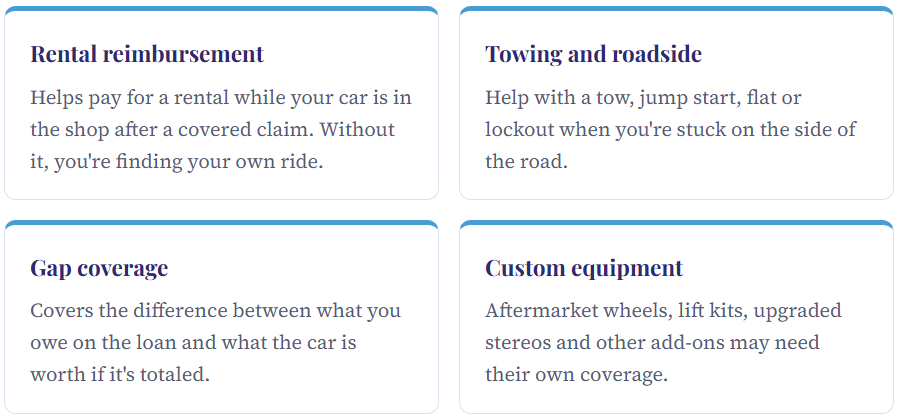
Mechanical breakdown is another one people assume is included. It isn’t part of a standard auto policy. A worn-out transmission is a maintenance issue, not an accident.
The gap math
Gap coverage matters more than it used to. CCC Intelligent Solutions found that 23.1% of auto claims in 2025 were flagged as total losses, a record high. Here’s what a total loss can look like on a financed car:
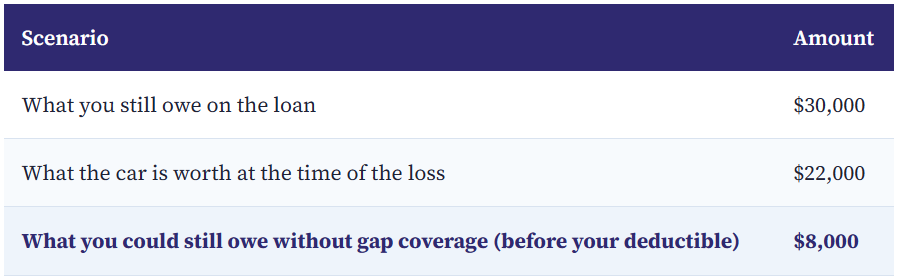
You’re not alone if this has happened to youIt’s a story we see online all the time. A driver who was told they had “full coverage” gets the bumper paid, the rest of the claim denied, and no rental car. The coverage they actually had did exactly what it was written to do. It just wasn’t what they thought they bought.
The Kansas pieces most people have never heard of
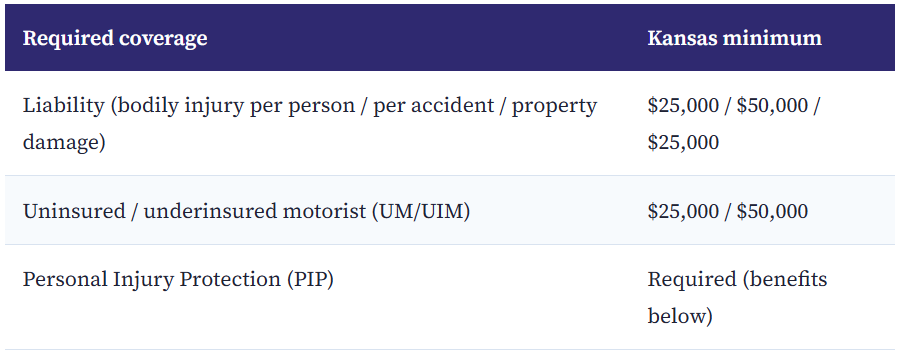
Kansas requires more than many states do. Even a minimum Kansas policy includes three parts, according to the Kansas Insurance Department:
PIP runs out faster than you think
PIP is the no-fault part of your policy. It pays your own injury costs no matter who caused the wreck. The Kansas minimum benefits are:
An ambulance ride, an ER visit, and a few follow-up appointments can burn through $4,500 quickly. After that, you’re relying on health insurance, other coverages, or your own savings.
The form you probably signed and forgotUnder Kansas law, your uninsured and underinsured motorist coverage has to match your liability limits unless you turn down the higher amount in writing. A lot of people sign that rejection form at the counter to save a few dollars and never think about it again.
That rejection carries over every time the policy renews. If you can’t remember what you signed, it’s worth asking.
How underinsured coverage actually pays in Kansas
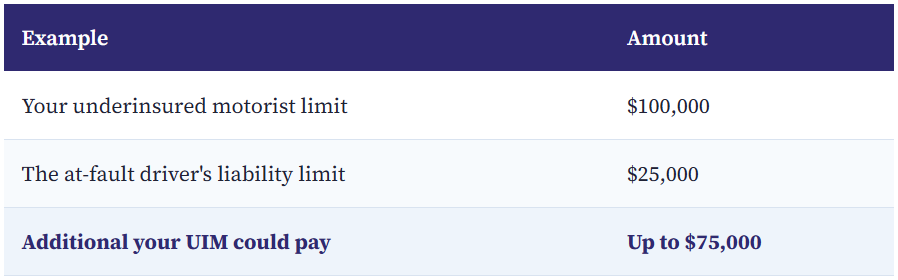
This one surprises people. In Kansas, underinsured motorist coverage pays the amount your limit is higher than the at-fault driver’s limit. It doesn’t stack on top.
When you can sue the other driver for pain and suffering
In plain English: in Kansas, you generally can’t sue the at-fault driver for pain and suffering unless your medical bills reach $2,000 or your injury is serious, like certain broken bones or a permanent injury. Below that, PIP is designed to handle it. That’s one more reason your own coverage matters so much.
Why the real numbers matter more than the label
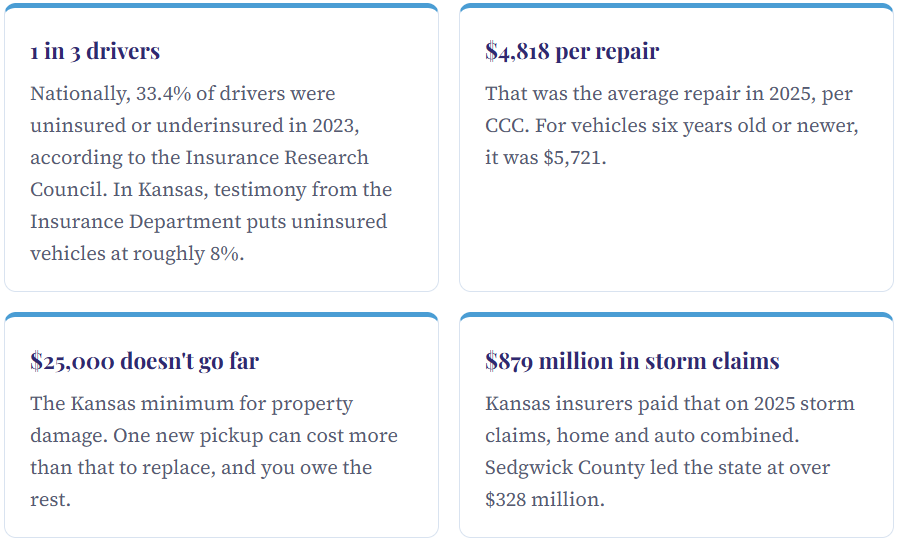
Here’s what’s actually on the road with you:
Your comprehensive deductible is your hail deductibleHail damage to your car falls under comprehensive. If you dropped comp on an older vehicle, or raised the deductible high to save money, that’s the number you’ll be living with after the next storm rolls through Wichita.
What to ask your agent instead
Skip “Do I have full coverage?” It can’t be answered honestly. Ask about real situations:
- If I hit a brand-new pickup with three people inside, would my limits be enough?
- If I’m hit by someone with no insurance, or not enough, what happens?
- If my car is in the shop for three weeks, how do I get around?
- If my car is totaled and I owe more than it’s worth, who pays the difference?
- If hail totals my car, what’s my out-of-pocket cost?
Do a quick deductible check
With premiums up, a lot of drivers have raised deductibles or dropped comp and collision entirely. Sometimes that’s the right call. Just make sure the savings are worth the gap you’re accepting. If you’re financing, check your loan paperwork too. Lenders often cap how high your deductible can go.
“When an agent says ‘you’re fully covered,’ that’s a promise no policy keeps. Our job is to show you exactly what your policy does and doesn’t do, before you need it.”
Marc Shook, Shook Insurance Agency
Let’s look at what you actually have
Bring us your current policy, and we’ll walk through these scenarios with you, line by line. No jargon, no pressure. Just straight answers so there are no surprises later.
Shook Insurance Agency • 3931 N Ridge Rd, Ste 102, Wichita, KS 67205 • 316-282-8006 • shook-insurance.com
This post is for general educational purposes and does not constitute legal or insurance advice. Coverage varies by policy and carrier. Sources: Kansas Insurance Department Auto Shopper’s Guide; K.S.A. 40-284 and 40-3117; Kansas Department of Insurance 2025 storm claims data (March 2026); CCC Intelligent Solutions Crash Course 2026; Insurance Research Council, Uninsured and Underinsured Motorists: 2017 to 2023; NAIC.