
Winter in Wichita: How to Keep Frozen Pipes, Ice Storms, and Sprinkler Lines From Turning Into a $30,000 Claim
A simple plan for before the first hard freeze, during a power outage, and after a pipe bursts, from the agency that handles the claims.
Remember last January? The storm that rolled through January 23 to 25 dropped 6 to nearly 8 inches of snow across Sedgwick County and set a January snowfall record for the Wichita area. Then the real cold showed up, with wind chills well below zero for days.
That’s exactly the kind of week that fills our phones with frozen pipe calls. The good news: most of that damage is preventable, and a little prep now can be the difference between a quick fix and a claim that takes over your winter.
How cold does it have to get before pipes freeze?
Pipes in unheated or uninsulated spots are at risk once temperatures drop below about 20°F. But pipes can freeze at warmer temperatures if they run through a garage, crawl space, attic or exterior wall, where cold air hits them directly.
Kansas gets hit harder than people expect. We sit right where warm and cold air masses collide, so a 50-degree afternoon can turn into a subzero night with very little warning. Houses don’t get time to adjust.
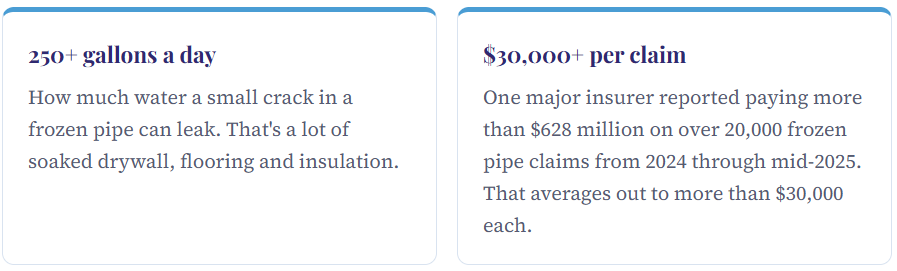
Marc’s rule: 55 degrees, no exceptionsKeep your thermostat at 55°F or higher all winter, even when you’re out of town. That number matters for more than comfort. It shows up again when we talk about claims.
Your before-the-first-freeze checklist
Knock these out in October or early November, before the first hard freeze:
1. Outdoor faucets
Disconnect hoses, shut off the water to outdoor faucets if you can, and cover them with insulated caps. Many older homes don’t have frost-free faucets.
2. Exposed pipes
Insulate pipes along exterior walls, in the crawl space, and in the garage. Seal gaps and cracks that let cold air reach them.
3. Main water shutoff
Find it now, make sure it turns, and show everyone in the house where it is. In a burst pipe, every minute counts.
4. Appliance hoses
Replace washing machine and dishwasher supply hoses older than 10 years. Braided steel hoses hold up better than rubber.
Don’t forget the roof: ice dams
An ice dam is a ridge of ice that forms at the edge of your roof. Heat from the house melts snow higher up; the water runs down, refreezes at the cold edge, and the trapped water backs up under the shingles and into your ceiling.
To prevent them: clean your gutters, add attic insulation if it’s thin, and seal the attic hatch so warm air from the house doesn’t heat the roof deck.
When to winterize your sprinklers in Wichita
For systems on city water, plan on October to early November. Well systems can sometimes wait a little longer, but don’t push your luck. Whatever you do, don’t wait for the first freeze. The backflow device, the above-ground valve assembly near your house, is usually the first thing to crack.
Wichita’s backflow ruleThe City of Wichita requires a working backflow device on every irrigation system connected to city water. That device keeps sprinkler water from flowing back into the city’s drinking water.
Backflow devices must be tested every year and rebuilt every 5 years by a licensed contractor. Customers who don’t keep up risk having their water shut off. A cracked device from a hard freeze means a repair bill on top of the test.
Why a cracked sprinkler line is sneaky
A broken underground line can leak for weeks or months without anyone noticing. Meanwhile, it can soak and wash out the soil near your foundation.
Here’s the insurance side: coverage for outdoor and underground irrigation lines is often limited or excluded, and it varies from policy to policy. Don’t assume. Check your policy, or ask us, before it becomes a problem.
What to do when an ice storm knocks out the power
1. Protect the pipes first
- Let faucets drip, especially on exterior walls, and open the cabinets under sinks so house heat can reach the pipes.
- If the outage looks like it will last a while, shut off the main water valve and open faucets on the lowest floor to drain the lines.
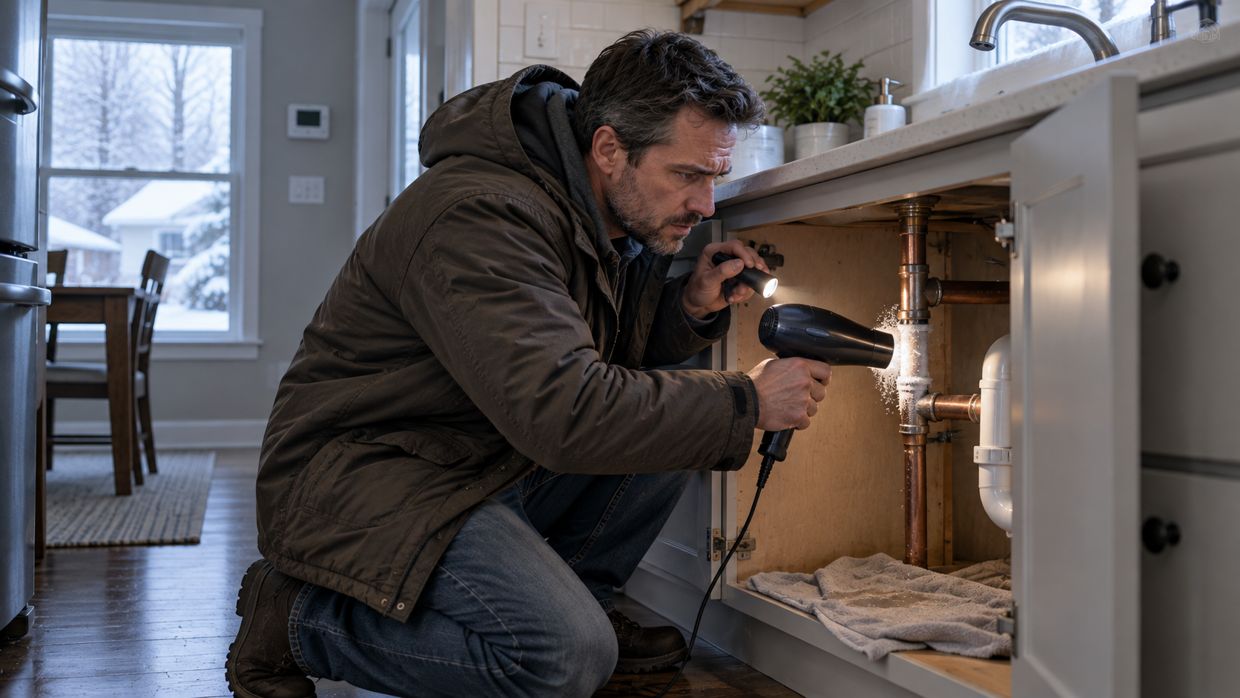
- If a pipe does freeze, thaw it slowly with a hair dryer or warm towels. Never use an open flame.
2. Generators and heaters: the part that can kill you
Every winter, people die trying to stay warm. Portable generators cause roughly 100 carbon monoxide deaths a year in the U.S. Run a generator only outside, at least 20 feet from the house, and never in the garage, even with the door open.
Space heaters are the other big one. According to the National Fire Protection Association, they’re involved in about a third of home heating fires and the vast majority of home heating fire deaths. Keep them 3 feet from anything that can burn, turn them off when you leave the room or go to bed, and plug them straight into the wall. Never use an extension cord.
3. Spoiled food
Some homeowners policies offer limited coverage, often around $500, for food spoiled when a neighborhood-wide outage takes out your fridge and freezer. It usually won’t apply if you caused the outage yourself or your service was shut off for nonpayment. Check your policy, and take photos before you toss anything.
If money is tight: the Kansas Cold Weather RuleFrom November 1 through March 31, the Kansas Corporation Commission’s Cold Weather Rule keeps regulated utilities from disconnecting your service when temperatures are forecast to drop below 35°F within the next 48 hours. It also lets you spread an overdue balance over 12 months. Call your utility before you fall behind.
Will insurance pay if my pipes burst?
Usually, yes. Most homeowners policies cover water damage from a pipe that bursts suddenly and accidentally. The claims that get denied usually come down to one thing: the heat wasn’t kept on, or the house was left empty without the right precautions.
There’s no grace periodUnder many standard policy forms, the freeze exclusion can apply whether the house sat empty for six days or six months. To keep your coverage, you generally need to show one of two things: you kept the heat on, or you shut off the water and drained the lines.
Proof matters. A gas bill that shows steady use, or a plumber’s invoice showing the house was winterized, can make all the difference.
This is especially important if you:
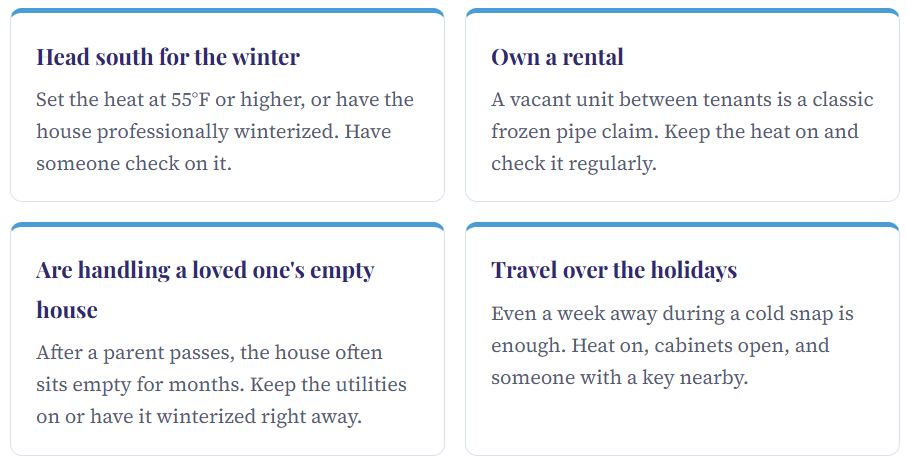
What if the whole neighborhood loses power and your pipes freeze? A widespread outage usually won’t sink a claim by itself, but you’re still expected to do what you reasonably can to limit the damage once you know about it.
“Shut the main, call a plumber, call me. In that order.”
Marc Shook, Shook Insurance Agency
Get ready before the first freeze
Not sure how your policy handles frozen pipes, sprinkler lines, or an empty house this winter? Give us a call. We’ll walk through it with you now, so you’re not finding out in the middle of a cold snap.
Shook Insurance Agency • 3931 N Ridge Rd, Ste 102, Wichita, KS 67205 • 316-282-8006 • shook-insurance.com
This post is for general educational purposes and does not constitute legal or insurance advice. Coverage varies by policy and carrier. Sources: National Weather Service Wichita January 23 to 25, 2026 storm summary; IBHS winter weather guidance; City of Wichita Backflow and Cross Connection Control program; Kansas Corporation Commission Cold Weather Rule; U.S. Consumer Product Safety Commission; National Fire Protection Association.